What Does "6-7" Mean? A Parent's Guide
Quick Answer
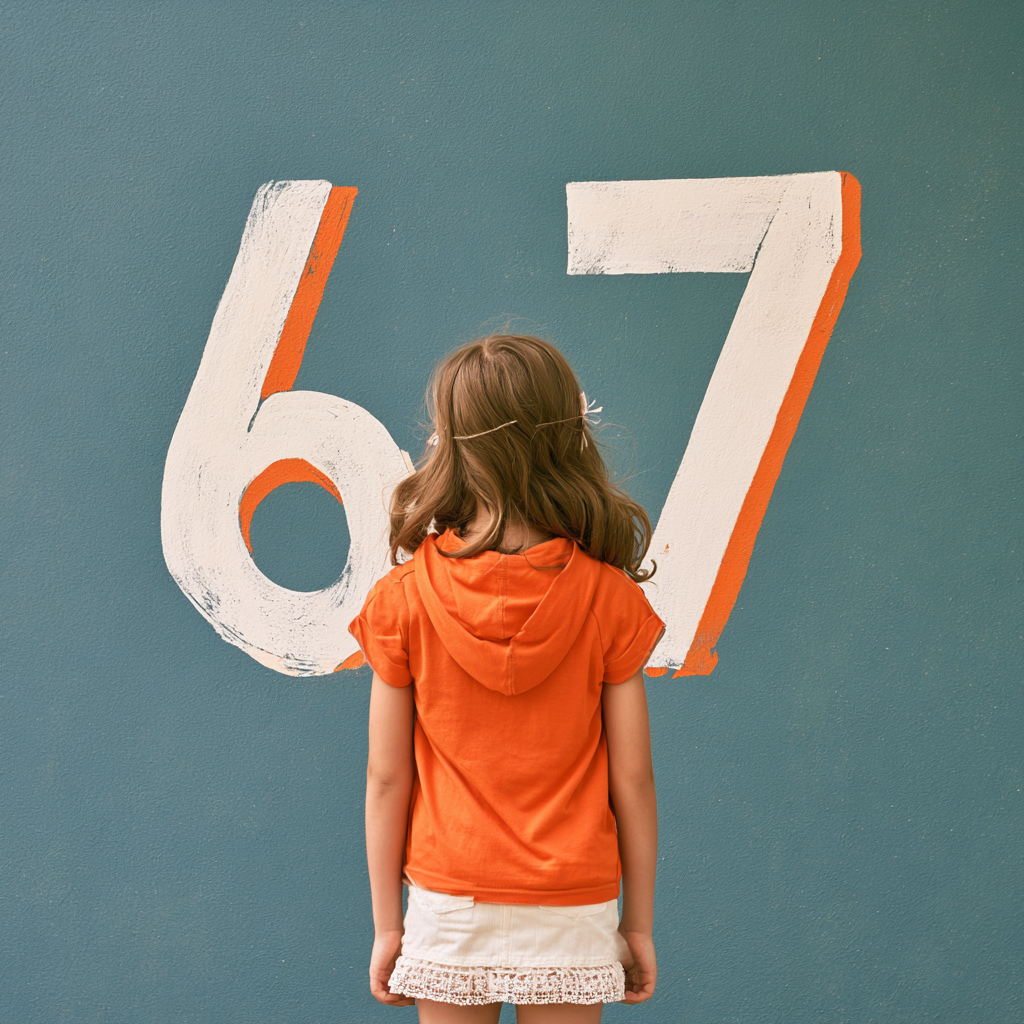
"6-7" (also written "67" and said out loud as "six seven") is a viral phrase kids shout that has no actual meaning. It comes from a 2025 rap song and spread through basketball videos, TikTok, and YouTube Shorts, where kids yell it whenever the numbers six and seven come up, often with an up-and-down hand motion. The phrase itself is harmless and is mostly used as a joke or an in-group signal, though the song it came from is an explicit drill track with references to gun violence.
What Does "6-7" Mean?
The short version of the 6-7 meaning: nothing. That is the joke.
Merriam-Webster defines "six seven" as "a nonsensical expression connected to a song and a basketball player." Dictionary.com named it the 2025 Word of the Year and described it as "a burst of energy that spreads and connects people long before anyone agrees on what it actually means."
In practice, kids use it three ways:
How it is used: As a reaction to the numbers
What the child means: Someone said "six" or "seven" or a score hit 67, so it gets shouted
How it is used: As a joke answer
What the child means: A silly, deliberately meaningless response to a question
How it is used: As "so-so"
What the child means: Occasionally used to mean "eh, middling," paired with a wobbling hand gesture
The third meaning is the closest thing to a definition, and even that is inconsistent. Most of the time, kids are saying it because saying it is funny and because everyone else is saying it.
Why Are Kids Saying "6-7"?
The phrase became a way to signal you are in on the joke. Linguist Taylor Jones described it to CNN as a shibboleth, a phrase that marks membership in a group. Saying it shows "a willingness to have fun," and not getting it marks you as an outsider.
A few things made it spread fast:
It requires no skill, no context, and no explanation, so any kid can join in.
It is tied to a hand gesture, which makes it work in silent short-form video.
Basketball edits featuring NBA player LaMelo Ball, who is 6 feet 7 inches tall, gave it endless source material.
Short-form platforms rewarded repetition, so YouTube Shorts and TikTok pushed it to millions of kids in weeks.
It got so repetitive that some teachers banned it in class, which of course only made it funnier to say.
Examples of How Kids Use "6-7"
"What time is it?" "6-7." A non-answer. The child is being deliberately silly, not telling you the time.
Teacher says "turn to page sixty-seven," and half the class yells "6-7!" A group reflex to hearing the numbers. This is the classroom version that got it banned in some schools.
"How was the movie?" "Eh, 6-7." (with a wobbling hand) The "so-so" usage. Roughly means "it was okay, nothing special."
Watching a game: player scores, the score is 67, and your kid shouts "6-7!" Sports are the meme's home turf. Any appearance of those numbers triggers it.
"You're so 6-7." Usually teasing between friends, meaning something like "you are being random" or "you are cringe." Tone matters more than the words here.
Where Did "6-7" Come From?
The traceable origin is the drill rap song "Doot Doot (6 7)" by Philadelphia rapper Skrilla, which circulated in December 2024 and was officially released on February 7, 2025. The numbers repeat at the beat drop, which is what made the clip usable in short videos.
What "6 7" meant in the song is genuinely unknown. Skrilla has said, "I never put an actual meaning on it, and I still would not want to." Commentators have speculated it refers to 67th Street in Philadelphia, a police radio code, or something else, but none of that is confirmed, and it should be treated as speculation rather than fact.
From there it spread through basketball content. Overtime Elite player Taylen Kinney used it constantly and became known as "Mr. 6-7," and a viral clip of a young fan shouting it at a basketball game in March 2025 turned it into a full internet phenomenon.
Current status: as of 2026 the meme has faded considerably. Wikipedia's coverage notes that by March 2026 it was declining as part of the so-called "Great Meme Reset," and older kids now mock people who still say it. Many younger kids kept using it well after that point.
Is "6-7" Inappropriate for Kids?
Generally: Harmless, with one context caveat.
The phrase itself contains no profanity, no sexual meaning, no violence, no slur, and no drug reference. There is no hidden meaning that parents are missing. It is two numbers.
The caveat is the source material, not the phrase:
The original song is explicit. "Doot Doot (6 7)" is a drill track containing references to gun violence and explicit language. A child who says "6-7" has almost certainly heard the sound clip. Whether they have heard the full song is a separate question worth knowing the answer to.
The word travels with everything else. Because the meme lived on Shorts and TikTok, it often appears in compilation videos and comment sections alongside content that was not made for kids.
Tone can turn it into teasing. "You're so 6-7" can be friendly or can be a jab, in the same way any slang can be.
So the honest assessment: the word is fine, the ecosystem around it is worth a look.
Should Parents Be Concerned?
No, not about the phrase.
Experts who have looked at it, including those quoted by CNN, describe it as normal youthful slang with no evidence of harm to literacy or thinking. Every generation invents a phrase adults find maddening. This one is unusual mainly for how fast and how far it spread.
The reasonable time to pay closer attention is not when your child says "6-7." It is when you notice the surrounding content: full explicit songs on repeat, creators whose videos are aimed at a much older audience, or slang showing up that is genuinely aggressive or sexual rather than nonsensical. The phrase is a signpost pointing at what your child is watching, and that is the more useful thing to understand.
What Parents Should Know
Repeating it is not a red flag. Constant repetition is the entire point of the joke, not a sign of anything.
Reacting strongly makes it better. Kids escalate the bit when adults get annoyed. Teachers who joined in reported it dying out within seconds.
The song is worth a listen, once. Hearing the original track tells you what your child has been exposed to, which is more informative than the phrase itself.
Slang moves faster than you can track. By the time a term reaches parents, kids are often already done with it. Knowing where your child spends time matters more than memorizing vocabulary.
It works as a conversation opener. Asking "where did you first hear that?" usually gets you a channel name, which tells you far more than the definition does.
Related Slang Parents May Hear
Skibidi: A nonsense word from the "Skibidi Toilet" YouTube series, used to mean good, bad, or nothing at all.
Rizz: Charisma or flirting ability, short for "charisma."
Aura: A measure of how cool someone seems, gained or lost in points ("that cost you aura").
Brain rot: Low-quality, hyper-repetitive online content, and also the state of consuming too much of it. Kids use it self-mockingly.
Sigma: Someone independent and impressive. Now mostly used ironically.
Gyatt: A crude exclamation about someone's body. This one is worth knowing, since it is not harmless in the way 6-7 is.
Mewing: A jaw-line technique from TikTok, often used as a gesture meaning "be quiet, I'm mewing."
Chat: Addressing the room as if livestreaming, as in "chat, is this real?"
Kids' language changes faster than any glossary can keep up with, and knowing one word is only a small piece of understanding what your child is actually watching. KidWatch analyzes your child's YouTube viewing and shows you the channels, videos, Shorts, and trends behind the words they bring home, including language worth a second look. No blocking, no spying, just a clearer picture of their online world.
Frequently asked questions
What does 6-7 mean in slang?
What does 6-7 mean on YouTube and Shorts?
Is 6-7 a bad word?
Why do kids say 6-7 over and over?
What age group says 6-7?
Do kids still say 6-7?
Should I ban my child from saying it?
See what YouTube is really teaching your kids
KidWatch turns your child's watch history into a plain-English safety report.
Get started