What Does "No Cap" Mean? A Parent's Guide
What Does "No Cap" Mean?
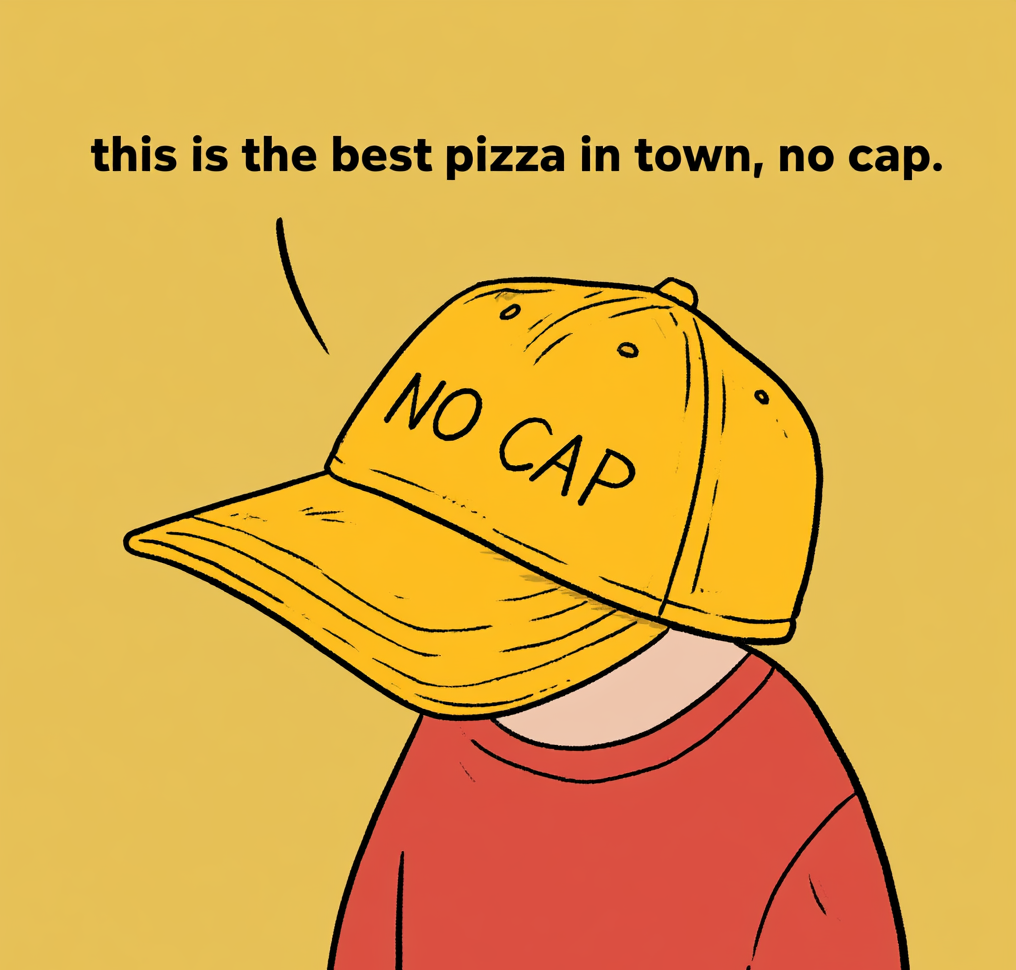
No cap means "no lie," "for real," or "I am being completely honest." Kids add it to a statement to stress that they are not exaggerating or joking. For example, "this is the best pizza in town, no cap" means "and I genuinely mean that."
To understand "no cap," it helps to know "cap." On its own, cap means a lie, a boast, or an exaggeration. So "you're capping" means "you're lying," and "no cap" means the opposite: "I'm telling the truth." Kids also use a baseball cap emoji to accuse someone of lying.
You will also see "no cap" shortened or stacked with other slang, like "fr no cap" (for real, no lie) for extra emphasis. However it is written, the job is the same: to promise the listener that the speaker is not exaggerating. It is basically a verbal underline on whatever they just said.
| No Cap at a glance | |
|---|---|
| What it means | "No lie," "for real," "I am being honest" |
| What "cap" means | A lie, a boast, or an exaggeration |
| Where it is from | African American English; spread through hip-hop and TikTok |
| Safe for kids? | Yes, harmless |
Why Are Kids Saying "No Cap"?
No cap became mainstream through hip-hop and then TikTok and Twitter. It is a fast, punchy way to add emphasis, similar to older phrases like "for real" or "I swear." Because it is short and works in both texts and speech, it slots naturally into how kids talk online and in person.
It also spreads because it is so easy to drop into any sentence. You can put "no cap" at the start or the end, use it in a text, or say it out loud, and it instantly signals sincerity. That flexibility is a big reason it has outlasted a lot of shorter-lived slang and become a near-permanent part of how many kids talk.
Examples of How Kids Use "No Cap"
- "That movie was amazing, no cap." The speaker is stressing they genuinely mean it.
- "No cap, I studied for six hours." Emphasizing that a surprising claim is true.
- "You're capping, there's no way that happened." Accusing someone of lying or exaggerating.
- "He said he's the best player, cap." Calling a boast a lie; here a single "cap" flags the statement as false.
- "I'll be there at 8, no cap." Promising sincerity, like saying "I promise."
- "No cap, that's my favorite show ever." Stressing that a strong opinion is completely sincere.
Where Did "No Cap" Come From?
According to Merriam-Webster and Dictionary.com, "cap" as slang for lying or boasting comes from African American English, with examples recorded in the mid-1900s. The phrase spread widely through hip-hop, including Atlanta rap, and appears on social media by at least 2012. Its use exploded with TikTok in the late 2010s.
Because the roots are in African American English and hip-hop, "no cap" is one of many everyday phrases that moved from Black culture into mainstream teen speech through music and social media. Knowing that history is a small but useful reminder that a lot of what sounds like brand-new internet slang actually has much deeper origins.
Is "No Cap" Inappropriate for Kids?
Generally: Harmless. No cap is not profane, sexual, violent, or hateful. It simply means "honestly" or "no lie." It is one of the safest and most common slang phrases kids use today.
The only thing to keep in mind is what follows it. "No cap" adds emphasis to whatever a person is saying, so it will show up before both harmless and edgier statements, just like "seriously" or "I swear" would. The phrase itself is clean.
Should Parents Be Concerned?
No. Hearing "no cap" is completely normal and not a warning sign of anything. It is one of the most widely used slang terms across all ages of kids and teens.
If your child says it constantly, that is just a verbal habit, the way earlier generations peppered speech with "literally" or "for real." There is nothing to correct beyond ordinary reminders about clear communication.
If you are ever unsure whether your child is being sincere, "no cap" is actually a small gift: it is their own way of flagging that they mean what they are saying. Rather than correcting the slang, you can simply take the cue and respond to the honest message underneath it. Treating it as communication, not attitude, keeps the conversation open.
What Parents Should Know
- It means "no lie." No cap is a stamp of sincerity added to a statement.
- "Cap" is the opposite. Cap means a lie or a boast, so "you're capping" means "you're lying."
- Watch for the emoji. A baseball cap emoji is often used to call something a lie.
- It is harmless. The phrase carries no hidden dangerous or adult meaning.
- Focus on the message. What comes after "no cap" matters more than the phrase itself.
- It crosses all ages. Younger kids and teens alike use it, so it is not a sign of any particular online rabbit hole.
Related Slang Parents May Hear
- Bet means "okay," "sounds good," or "I'm in."
- Sus means suspicious or untrustworthy.
- Fr / frfr means "for real" or "for real for real," used for emphasis like no cap.
- On God is another way of swearing that something is true.
- Deadass means "seriously" or "I'm not joking."
- Lowkey / highkey mean "somewhat or secretly" and "very or openly."
- Glazing means praising someone way too much.
Frequently asked questions
What does no cap mean?
What does cap mean by itself?
Where did no cap come from?
Is no cap a bad word?
Should I be worried if my child says no cap?
See what YouTube is really teaching your kids
KidWatch turns your child's watch history into a plain-English safety report.
Get started